
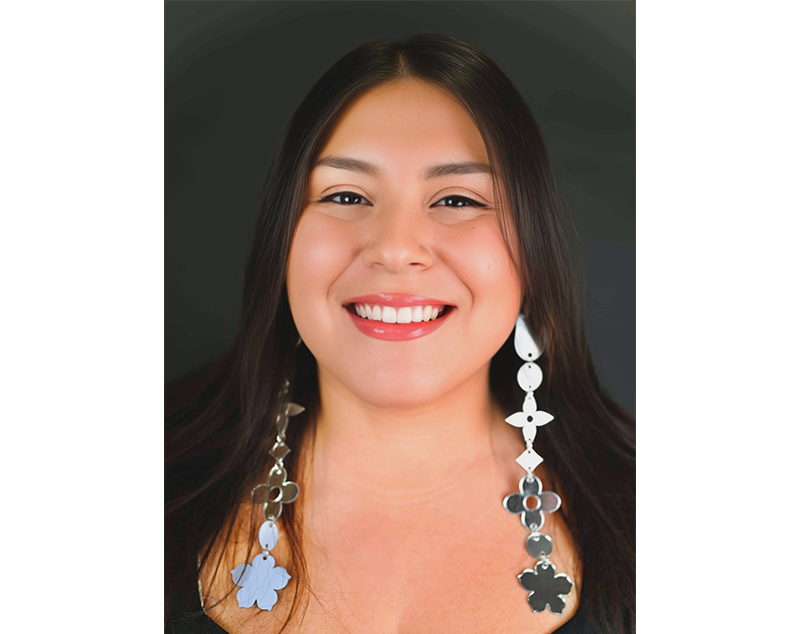
Serena Mendizábal shares an empowering message in this week’s Changemaker Chat. With a passion for community engagement and education, Serena is the Managing Director at Sacred Earth, supporting Indigenous communities’ unique needs with capacity building, training, and self-determination. Serena’s story realizes a future vision where the just transition blossoms beyond the energy sector, with community voices at the forefront of the climate transformation.
Q: Where did your journey with climate activism and grassroots organizing begin?
A: I’ve been working in the climate energy sector for nearly a decade, specializing in justice and Indigenous rights. What really stood out for me was the work I did back home in my community of Six Nations. When I was 18, I worked in a summer position at the Six Nations of the Grand River Development Corporation to create a portfolio around clean energy. It was exactly what I wanted to do — contribute to the health of our community through communications, community engagement, and education.
At the time, Hydro One was re-commissioning the Niagara Reinforcement Line. It became quite contentious in the community; a lot of people didn’t want the project to go forward. This sent me on a path to understand climate solutions and green energy projects from the perspective of justice and sovereignty. I asked myself a lot of difficult questions — what is going to make us well? Is it putting big projects in our community? In the process, are we supporting Indigenous priorities, informed consent, and community participation?
These questions brought me to Sacred Earth. I wanted to do projects in a good way, with a good mind. I’ve been dedicating my time to answering these questions about how to make a transition “just” ever since.
Q: What does a “just transition” mean to you?
A: We are in an era where Indigenous-led energy projects are taking shape. We are innate to the conversation around the energy transition, and Canada knows the transition can’t happen without us. Where there’s still room for growth is this idea of community-led and owned projects. Oftentimes, proponents or developers come into communities to get a checkmark for Indigenous participation — they’re working to get us on the same page as them.
With a community project, we make our own agenda. Indigenous renewable energy projects are so successful because we train and build capacity from the ground up — within our youth, Elders, leaders. We implement our own vision, and make sure communities don’t become economic hostages to access money for services.
We also want to expand the conception of a just transition. The idea is being narrowed by the energy transition, but it’s a larger transformation happening within our territories — tied to our sovereignty, cultures, languages, and beyond. When I think of a just transition, it comes back to building strong communities that care for one another.
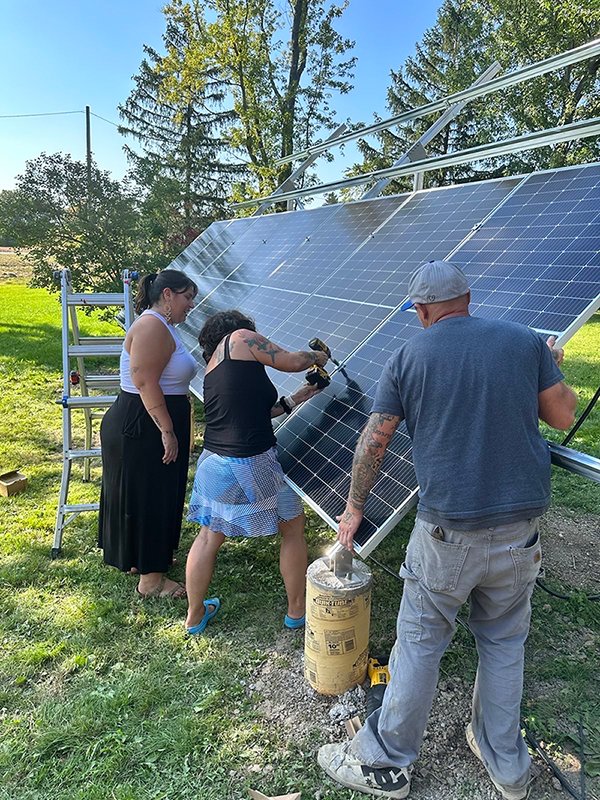
Photo: Serena working with No More Silence on their solar installation for the Hummingbird Healing Lodge in Six Nations, ON
Q: What are some Sacred Earth projects that you are especially proud of?
A: A project near and dear to my heart is one in my own community, with the Sour Springs Longhouse. The longhouse is our place of ceremony, harvest, even funerals. It’s representative of our hereditary governance system that’s been passed down since the Great Law of Peace. It was really special to work on this three-phase project involving solar energy, retrofits, and our seed storage. Thanks to heat pumps, our propane emissions have dropped by 50%.
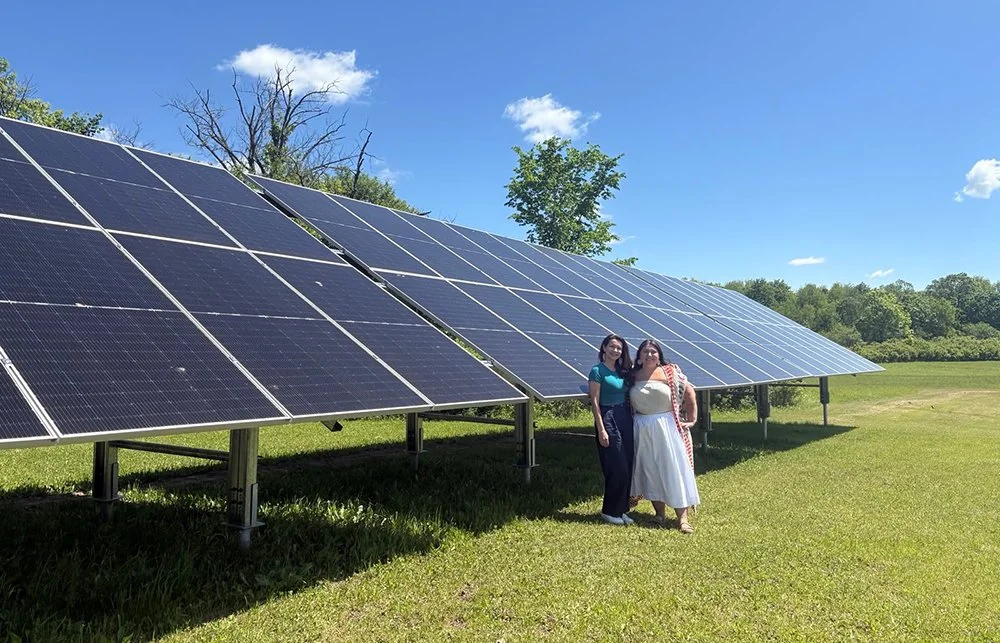
Photo: Serena Mendizábal and Melina Laboucan-Massimo, Sacred Earth, at the Sour Springs Longhouse solar project
There’s a misconception that Indigenous people are inherently against development. Rather, we oppose development going forward without our leadership or consent. This project was a love letter to our community — we wanted to do things right by our people, pay it forward, and centralize our sovereignty as Haudenosaunee people. We brought people together, trained them on solar installation, design, and maintenance. It truly represents my own understanding of a just transition.
Sacred Earth’s projects are place-based — communities enact the governance and decision-making models they want, and we take the role as a resource to build up their visions. We don’t go in with our own agenda; we follow theirs.
Q: Why do you love what you do at Sacred Earth?
A: I get to work directly with communities in a way that follows my personal ethos of consent, leadership, sovereignty, justice, and liberation. It has been truly life-changing to help build capacity in areas where, historically, we haven’t been granted much access or inclusion. The best days of my life are when we launch these projects together. I love seeing the empowerment of our communities, and the joy and laughter this brings.
With the launch of Sacred Earth’s Just Transition Guide, we’ve seen that people are interested in creating accessible language, and learning how to implement just projects in communities. Now, we are entering a bridging phase to build in-community training. A lot of training opportunities focused on clean energy tend to bring people outside of their communities to learn.
We want to make those opportunities accessible for all. To scale up communities’ access to resources on education, training, capacity building, and community engagement. As someone who’s worked in these domains — who’s seen all the faults and gaps — I don’t want to work on projects unless we’re doing it right, with communities leading along every project stage.
Q: What are you doing to create hope?
A: I’ve found hope in the communities who invested time in me because they saw something in me. I’ve never built a building in my life, yet I’m working on a building that will store thousands of heritage seeds, supporting our food sovereignty. I’m learning a lot, and that builds hope within people — they can relate to the work we’re doing, to myself. I’ve shown that anyone can do this work, and with the right investment and community support, anyone has the ability to implement projects that realize their vision.
Ten years ago, I never would’ve thought that I could accomplish what I have today. But with the communities, networks, support, and care that have been gifted to me along my journey, anything became possible. I want to continue paying it forward as part of the younger generation, and continue asking the difficult questions — how can we make a good thing better, and how do we make sure no community is left behind?
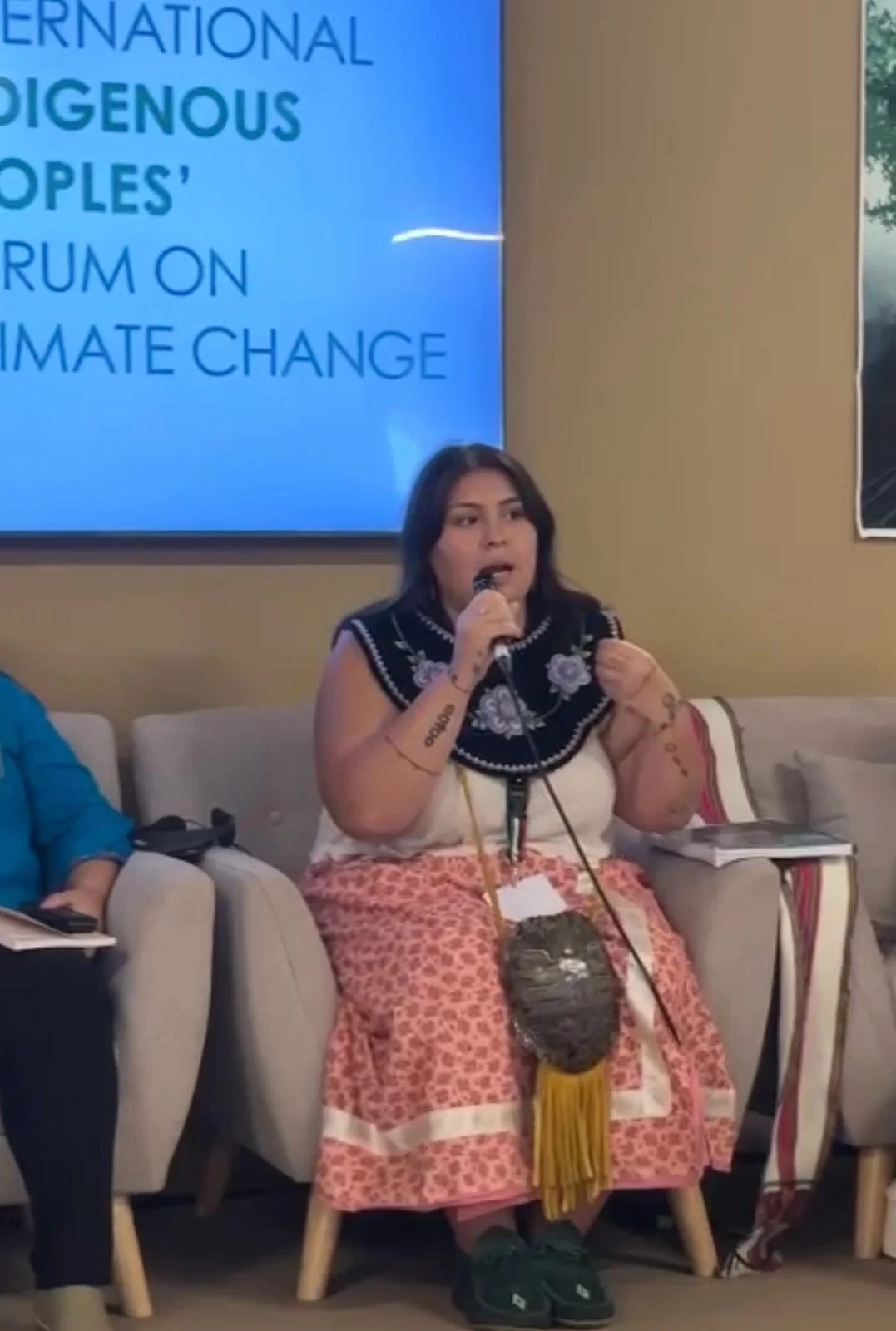
Photo: Serena speaking at the Indigenous Pavillion at COP28 in Dubai