

For this week’s Changemaker Chat, we sat down for a rare interview with Tony Pringle, CEO and Co-founder of Quinn+Partners, to discuss Canada’s role in the shifting economic climate and the ways Canada is blazing a trail of leadership and innovation in sustainability and climate action. Tony and his team have built a breadth of expertise that spans management consulting, finance, climate change, sustainability, and beyond.
Q: What role do you see Canadian consultancies like Quinn+Partners playing in response to recent U.S. shifts and impacts on market confidence?
A: We founded Quinn+Partners with a clear goal: to help companies and investors excel in a changing world by embracing sustainability. For more than a decade, that focus has shaped our work and our growth, and it has made us particularly well suited to periods of uncertainty — times that demand perspective, judgment, and a genuinely multidisciplinary view.

Our purpose is simple: we empower business to realize a sustainable future. That means helping organizations navigate complexity with confidence and create enduring value — not only for themselves, but for society more broadly. There is undeniably heightened uncertainty right now, particularly south of the border. Our role is to provide clients with trusted advice, discern which forces truly matter across markets, regulation, policy, and investment, and catalyze action to bolster their competitive success.
In moments like these, sound leadership is grounded in evidence, insight, and thoughtful collaboration. While the near-term path can feel uncertain, the long-term direction is exceptionally clear. The climate is changing, weather events are intensifying, and an energy transition is underway. Organizations that acknowledge this reality and act with intention today are better positioned to thrive tomorrow.
Photo: Tony at the Princess Margaret Cancer Foundation Ride
Q: How is Canada’s unique approach driving climate leadership and market innovation?
A: We are founded and headquartered in Toronto, with regional offices in Vancouver and Montréal, and we’re very proud of our Canadian roots. At the same time, we’ve been trusted advisors to U.S. and international firms for many years, which gives us a useful perspective on how different jurisdictions approach climate and sustainability.
This moment presents an opportunity for Canada to contribute meaningfully to the global conversation. One example is the way climate action is increasingly connected with Indigenous reconciliation in Canada — through equity ownership in infrastructure, respect for self-determination, and the integration of Indigenous and local knowledge systems.
Canada also benefits from a set of strong, long-term institutions. Large pension funds, banks, and Crown corporations are widely recognized for their governance and risk management. That long-term orientation allows them to invest thoughtfully through periods of transition. Many of our clients who manage significant physical assets have quietly been global leaders in decarbonization for years, focused on resilience and long-term value creation.
Finally, I would point to integrity as a deeply held Canadian value. Our regulatory environment provides important guardrails for credibility and trust, embedding those principles into how markets function. At a time when confidence in major institutions is under strain in many places, we increasingly see international clients look to Canada — and to Canadian firms — for that sense of reliability and trustworthiness.
Q: How can challenges across sustainability and climate action be reframed to spur innovation?
A: Challenge, when approached thoughtfully, is often a powerful catalyst for innovation and value creation. On a personal note, I’ve always enjoyed grappling with what are sometimes called “wicked problems.” There is no shortage of them today, and we feel genuinely honored that our clients trust us to help them work through complex and unresolved issues.
What continues to strike me is how often challenge becomes an opportunity when teams and stakeholders engage openly and collaboratively. We regularly see situations where the act of confronting complexity leads to new approaches, stronger relationships, and better business outcomes.
One example is the work we’ve seen emerge from the Collaboration for Climate Action forum, where major retailers come together to collectively address shared challenges. These are rarely straightforward problems. They require innovation, creativity, and a willingness to rethink how risk is shared and how value is created. In that sense, challenge can be an invitation — not just to endure — but to grow and innovate.

Q: How are you nurturing climate innovation and local talent in Toronto?
A: We’re very pleased to be unveiling our new Toronto headquarters during Toronto Climate Week. For us, it reflects a long-term commitment to climate leadership, excellence, and talent development in the city we call home.
Photo: Artist rendering of new Toronto Q+P headquarters on Prince Arthur Avenue

The space itself is a reimagined heritage building designed to reflect the future of sustainable, healthy, and collaborative work environments. We see it as a living lab — a place where we can test, learn from, and demonstrate the sustainability and resilience strategies we advise our clients on, and where others can experience those ideas in practice.
The building incorporates low-carbon materials and passive design principles, with a strong emphasis on air quality, natural light, and occupant health and well-being. It is targeting Toronto Green Standard Version 3 and will serve as a demonstration project within the Toronto 2030 District’s Net Zero Carbon Buildings Accelerator. Above all, it’s intended to be a tangible expression of our values and climate leadership.
Photo: New Q+P Toronto headquarters
Q: Why do you love what you do?
A: If you’re going to dedicate your life to something, I believe it should be meaningful. I studied economics and remain a strong advocate for markets as engines of innovation and efficient resource allocation. At the same time, we know that markets can fail when their limitations go unaddressed — whether that’s externalities, the tragedy of the commons, or how we define and measure value and growth.
I’m deeply motivated by reshaping our economic systems to address climate change and, in doing so, ensure they create lasting value for society. It’s demanding work, but it’s purposeful.
And I speak on behalf of the entire Q+P team when I say that combination is what continues to excite us every day.
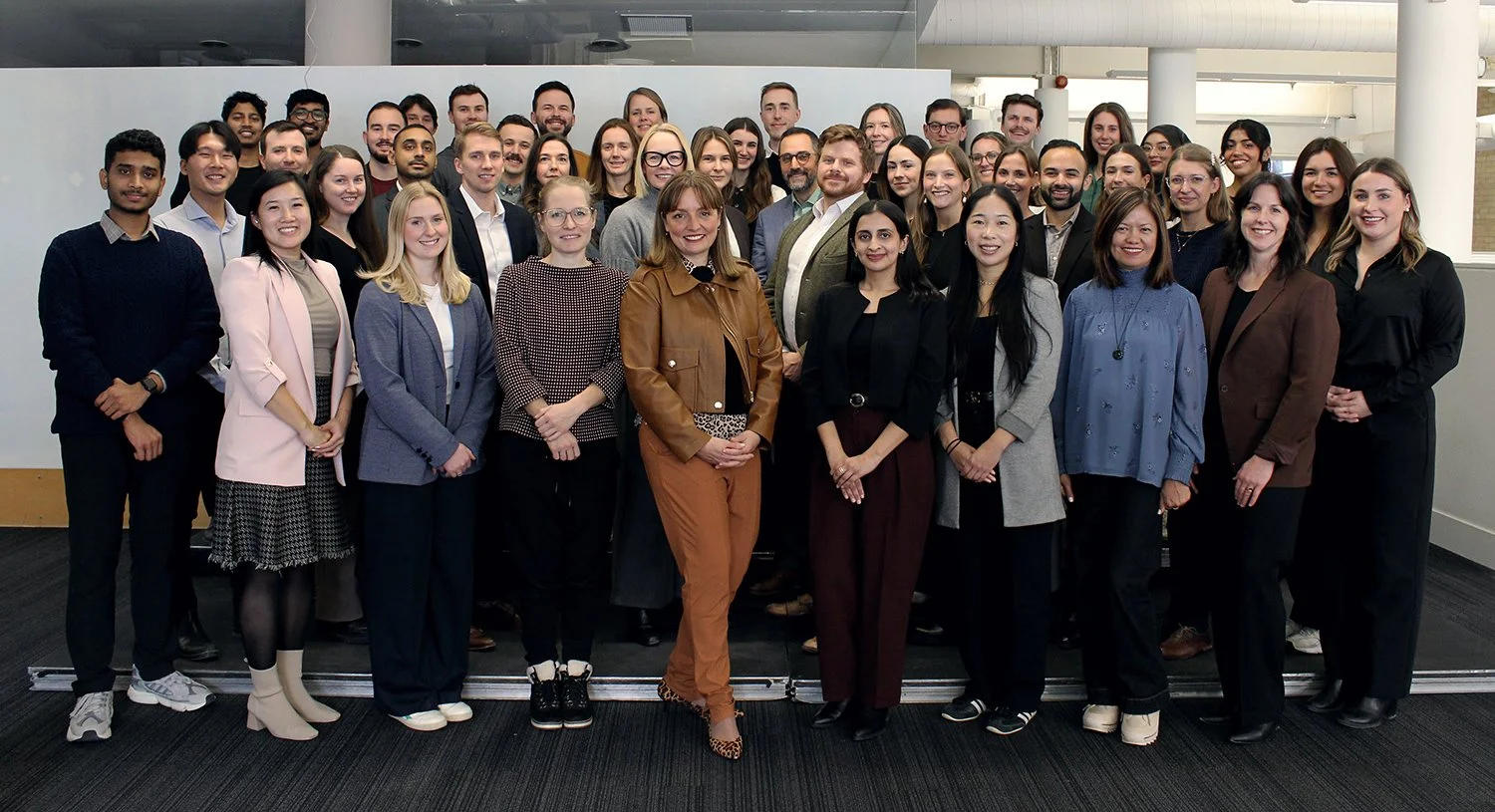
Photo: The Q+P team